Welcome to War and Tactics! War and Tactics Forum is currently undergoing some modifications that might disable features you are used to. This is unabvoidable as we have to update the forum engine to a new structure that is incompatible with many of the features we had used so far. The good news: WaT will be more secure and stable, and most of the features we uninstalled will be a natural part of the new structure anyway. For the rest we will be looking for solutions. (APR 23, 2018)
An interesting article (JUL 2023) whose contents I second.
I have voiced my doubts of an upcoming UKR counter offensive since October 2022 (focusing on the difficulty of integrating Western arms of a grand variety into a holistic concept of combined arms, w/o experienced sub officials), I feel my doubts were proven reasonable since, but I still have a lot of optimism about the UKR counter offensive(s), for various reasons (mainly logistics).
Yesterday ran into a (adequately long) article that expresses everything I feel from my analysis much more capable and in detail, recommended read:
The situation in Ukraine still favors Kyiv despite the limited progress made in the counteroffensive so far. Ukrainian forces attempted a limited mechanized penetration of prepared Russian defenses in the south in early to mid-June, but failed to break through the Russian lines. They then switched to slower and more careful operations while disrupting Russian rear areas with long-range precision strikes. Ukraine began the next, reportedly main, phase of its counteroffensive on July 26 with a determined drive to penetrate Russian lines in western Zaporizhia Oblast. It’s far too soon to evaluate the outcome of that effort, which is underway as of the time of this writing, but it is vital to manage expectations. Ukrainian forces are fighting now to break through the first line of long-prepared Russian defenses. Several lines lie behind it, stretching for many miles. Ukrainian progress will very likely alternate periods of notable tactical advances with periods, possibly long periods, of pause and some setbacks.
Quote
The Ukrainian counteroffensive can succeed in any of several ways. First, the current Ukrainian mechanized breakthrough could succeed, and the Ukrainians could exploit it deeply enough to unhinge part or all of the Russian lines. Second, Russian forces, already suffering serious morale and other systemic problems, could break under the pressure and begin to withdraw in a controlled or uncontrolled fashion. Third, a steady pressure and interdiction campaign supported by major efforts such as the one now underway can generate gaps in the Russian lines that Ukrainian forces can exploit at first locally, but then for deeper penetrations.
Quote
Russia’s Problems
Reasons for confidence in the possibility of significant Ukrainian successes are closely tied to a number of fundamental challenges inherent to the Russian position in Ukraine and the Russian military. These cannot be resolved in 2023, so the opportunities they offer Ukraine are not fleeting. At the strategic level, the geometry of the theater favors Ukraine. At the strategic and operational levels, the lack of Russian reserves forces difficult and complex choices on the Russian military command in the face of Ukrainian counteroffensives. And at the tactical level the way the Russians are conducting defensive operations puts much greater pressure on Russian combat units than the lack of regular or large-scale movements on the map would suggest. All these problems are exacerbated by fundamental flaws in the Russian military itself.
Quote
Theater Geometry
The defining characteristic of this phase of the war is that the Russians must defend a ground line of communication (GLOC) consisting of a road and a rail line that runs from Rostov-on-Don at the northeastern edge of the Sea of Azov to Crimea. The Russians are dependent on this GLOC to supply their troops in southern Ukraine, as Putin had ordered Russian forces not to rely on the Kerch bridge for their logistics after the last major attack on the bridge. The break in that road bridge deprives the Russians of any fallback if the Ukrainians can threaten or cut the Rostov-to-Crimea GLOC.
This state of affairs favors Ukraine in an important way. If the Ukrainians can reach the Sea of Azov anywhere and hold their positions, they will have cut the GLOC. The Russians, thus, have to hold the entire thing. Put another way, the Ukrainians only have to win and hold in one sector to render virtually all the Russian-held territory west of their advance untenable. The Russians have to win everywhere all the time.
Quote
Reserves
The Russians suffer from an additional challenge in that they lack operational or strategic reserves.
A military without significant reserves has to require its troops on the frontlines to stay there indefinitely and can temporarily generate the effects of reserves only by pulling forces from one sector of the line to another to deal with unexpected opportunities or reverses.
Lateral transfers of forces from one part of an active line to another are undesirable. They can disrupt offensive or defensive operations in the sectors from which they are drawn and put great pressure on soldiers who must withdraw from combat in one area, move rapidly to another, and immediately launch into new fighting without time to rest men and repair or replace equipment. The fact that the Russian command has generated reinforcements for threatened sectors in this fashion rather than by sending uncommitted reserves, together with the widespread complaints about the lack of rotations of frontline units, strongly suggests that the Russians simply do not have uncommitted operational or strategic reserves.
RUS-UKR war SITREP AUG07 2023 - Russian Offensive Campaign Assessment, August 7, 2023
Cutoff: 071600Zaug23
Key Takeaways:
- Ukrainian forces continued counteroffensive operations on at least two sectors of the front on August 7. - Russian forces and occupation administrators continue to seek to mitigate the impact of recent Ukrainian strikes on logistics nodes along key Russian ground lines of communication (GLOCs) connecting occupied Crimea with occupied Kherson Oblast. - Russian opposition media outlet Verstka suggested that the Russian Investigative Committee and its head, Alexander Bastrykin, are directly involved in the forced deportation of Ukrainian children to Russia and the forced placement of Ukrainian children into Russian military training programs. - China's increasing misalignment with Russia on any settlement to end the war in Ukraine was reportedly evident at the talks in Jeddah, Saudi Arabia on August 5-6. - The Ukrainian delegation at the talks in Saudi Arabia presented a 10-point peace plan that reportedly included calls for global food security, nuclear safety, environmental security, humanitarian aid, and prisoner releases. - Ukrainian officials reported that Ukrainian and Russian forces conducted a prisoner-of-war (POW) exchange on August 7. - Russian forces conducted offensive operations along the Kupyansk-Svatove-Kreminna line, near Bakhmut, along the Avdiivka-Donetsk City line, along the Donetsk-Zaporizhia Oblast border, and in western Zaporizhia Oblast on August 7 and made advances in certain areas. - The Kremlin continues efforts to portray itself as adequately mobilizing the Russian defense industrial base (DIB) for a protracted war effort. - Russian occupation authorities continue to use maternity capital benefits to coerce Ukrainian civilians in occupied territories to accept Russian citizenship and increase social control in occupied areas.
RUS-UKR war SITREP AUG06 2023 - Russian Offensive Campaign Assessment, August 6, 2023
Cutoff: 061600Zaug23
Key Takeaways:
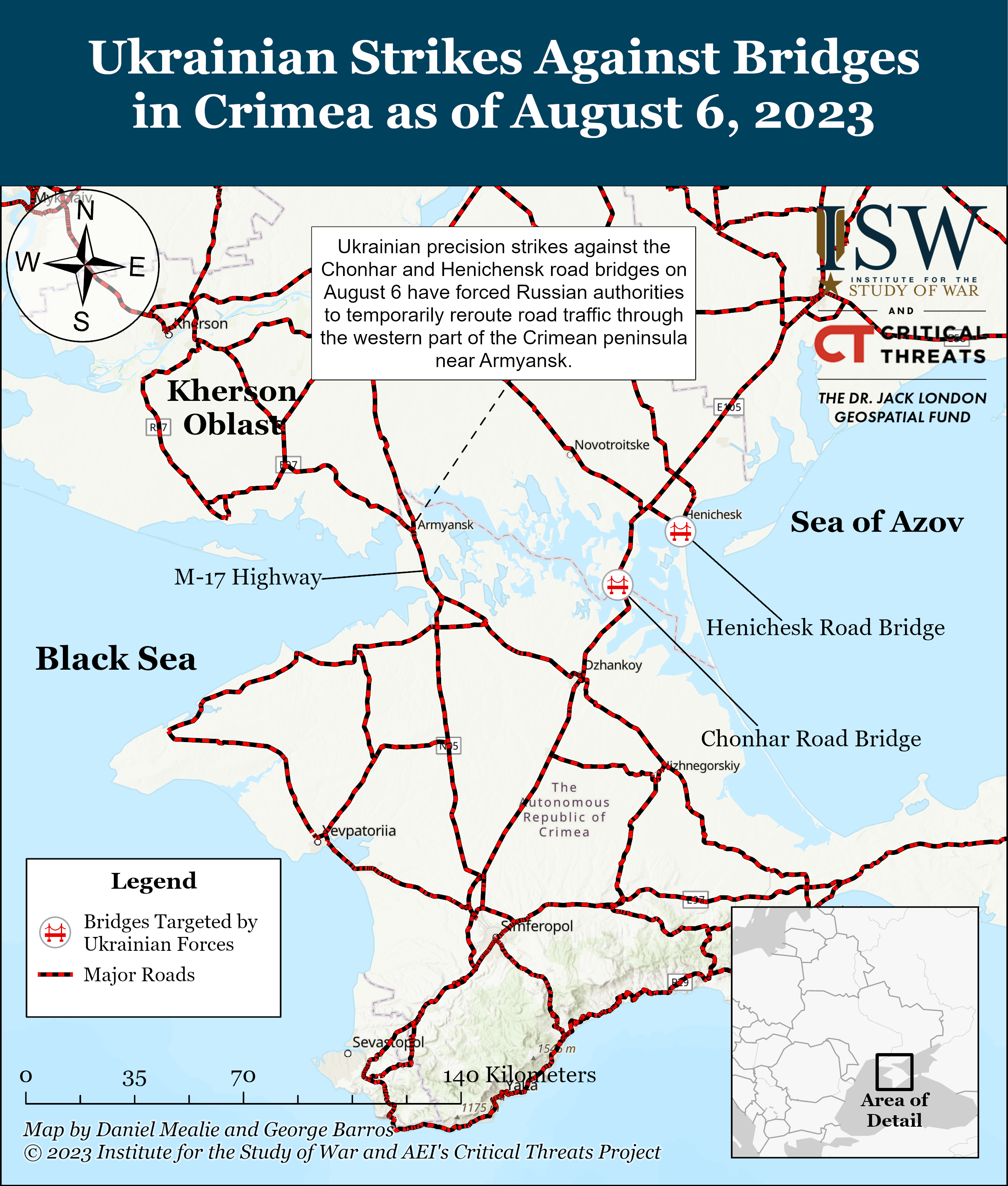
- Ukrainian forces struck two key road bridges along critical Russian grounds lines of communication (GLOCs) connecting occupied Crimea and occupied Kherson Oblast on August 6, causing Russian forces to reroute road traffic from shorter eastern routes to longer western routes.
- Ukrainian strikes on bridges along critical Russian GLOCs are a part of the Ukrainian interdiction campaign focused on setting conditions for future decisive counteroffensive operations. - Russian forces conducted one of the largest missile and drone strike series on Ukraine in recent months on the night of August 5-6. - Ukrainian officials stated that Ukrainian air defenses have destroyed 3,500 aerial targets since the beginning of Russia’s full-scale invasion of Ukraine on February 24, 2022. - International talks aimed at drafting the main principles for a future settlement to the war in Ukraine continued in Jeddah, Saudi Arabia on August 6. - Kremlin Spokesperson Dmitry Peskov gave an unclear and contradictory answer to a New York Times reporter who asked whether Russia seeks to conquer more Ukrainian territory beyond the four partially occupied oblasts that Russia illegally annexed in September 2022. - Ukrainian forces continued counteroffensive operations on at least two sectors of the front on August 6. - Russian forces conducted offensive operations along the Kupyansk-Svatove-Kreminna line, near Bakhmut, along the Avdiivka-Donetsk City line, in the Zaporizhia-Donetsk Oblast border area, and in western Zaporizhia Oblast August 6 and made advances in certain areas. - Russian military command finally allowed personnel of the Russian “Alga” volunteer battalion – which has been involved in the most combat intense frontlines in Donetsk Oblast since Fall 2022 – to return to Russia on leave. - Russian occupation authorities in Ukraine continue establishing institutional linkages between Russian and Ukrainian governance structures and social services in occupied Ukraine.
RUS-UKR war SITREP AUG05 2023 - Russian Offensive Campaign Assessment, August 5, 2023
Cutoff: 052230Zaug23
Key Takeaways:
- Ukrainian forces struck a Russian oil tanker on August 4 with a naval drone in the second attack on Russian ships in the Black Sea in two consecutive days. - Ukrainian officials issued a notice to mariners that Ukraine may strike vessels near Russia’s Black Sea ports – a measured response to continued Russian strikes against Odesa – Ukraine's main port – since July 17. - Ukrainian naval strikes are likely part of a deliberate interdiction campaign aimed at setting favorable conditions for larger counteroffensive operations. - Ukrainian forces continue to draw Russian forces to the Bakhmut area and fix them there despite a slower tempo of Ukrainian operations there. - Ukrainian forces conducted limited ground attacks in southern Ukraine on August 5, part of a continuing pattern of limited Ukrainian ground attacks accompanying Ukrainian efforts to interdict Russian logistics and headquarters in rear areas. - Senior officials from reportedly 40 countries, including the US, China, and India, began talks in Jeddah, Saudi Arabia on August 5 aimed at drafting a set of key principles to guide the future settlement of the war in Ukraine. - Russian forces conducted offensive operations northeast of Kupyansk, along the Svatove-Kreminna line, in the Bakhmut area, along the Avdiivka-Donetsk City front, in the western Donetsk-eastern Zaporizhia Oblast border area, and in western Zaporizhia Oblast and advanced along the Svatove-Kreminna line and the Avdiivka-Donetsk City front. - Ukrainian forces conducted offensive operations along the Svatove-Kreminna line, along the Avdiivka-Donetsk City front, in western Donetsk Oblast, in the western Donetsk-eastern Zaporizhia Oblast border area, and in western Zaporizhia Oblast and advanced along the Svatove-Kremmina line. - Pardoned Wagner Group convict fighters continue to increase recidivism rates in Russia. - Russian officials continue to transport Ukrainian children from occupied regions to Russia under the guise of summer vacations.
RUS-UKR war SITREP AUG04 2023 - Russian Offensive Campaign Assessment, August 4, 2023
Cutoff: 041700Zaug23
Key Takeaways:
- Ukrainian forces conducted a series of aerial and naval drone strikes against Russian logistics and port infrastructure in occupied Crimea and Krasnodar Krai (a key Russian naval base) on the night of August 3 to 4. - Russian milbloggers characteristically lambasted the Russian MoD for lying about the naval drone strikes and called on the Russian military to escalate activities in the Black Sea. - Ukrainian forces conducted counteroffensive operations on at least three sectors of the front on August 4. - Russian forces continued to counterattack but did not seize new or previously lost positions around Bakhmut on August 4. - The Kremlin continues to express its unwillingness to return to the Black Sea Grain Initiative in the absence of extensive concessions from the West. - Tula Oblast Governor Alexei Dyumin reportedly facilitated the reinstatement of the commander of the Russian 106th Guards Airborne (VDV) Division, Major General Vladimir Seliverstov, after meeting Putin’s Chief of Staff Anton Vaino on July 21. - Russian forces conducted offensive operations along the Kupyansk-Svatove-Kreminna line, near Bakhmut, in the Zaporizhia-Donetsk Oblast border area, and in western Zaporizhia Oblast on August 4 and made advances in certain areas. - A prominent Russian milblogger claimed that China’s “temporary” export restrictions on drones may severely impact the ability of Russian volunteers to supply drones to Russian servicemen fighting in Ukraine. - Russian authorities are continuing to deport Ukrainian children to Russia under the guise of summer camps.
RUS-UKR war SITREP AUG03 2023 - Russian Offensive Campaign Assessment, August 3, 2023
Cutoff: 031700Zaug23
Key Takeaways:
- Ukrainian forces continued counteroffensive operations on at least three sectors of the front on August 3 and reportedly advanced in some areas. - Russian forces conducted a series of drone strikes on August 3, primarily targeting Kyiv. - The Russian Ministry of Defense (MoD) took down Russian Airborne Forces (VDV) Commander Colonel General Mikhail Teplinsky’s August 2 speech, possibly due to his disclosure of Russian casualties in Ukraine. - Russian prosecutors reportedly classified the investigation into ardent Russian ultranationalist and former FSB officer Igor Girkin on August 2. - Russian forces conducted offensive operations along the Kupyansk-Svatove-Kreminna line, near Bakhmut, along the Avdiivka-Donetsk City line, and in the western Donetsk-eastern Zaporizhia Oblast border area on August 3 and made advances in certain areas. - Ukrainian forces continued counteroffensive operations on at least three sectors of the front on August 3 and reportedly advanced near Kreminna and Vuhledar. - The Kremlin is attempting to establish favorable conditions to attract additional volunteers to serve in the Russian Armed Forces. - A report from Yale University’s Conflict Observatory supports ISW’s longstanding assessments that Russian and occupation authorities are using forced passportization measures to consolidate social and legal control over occupied areas of Ukraine.
RUS-UKR war SITREP AUG02 2023 - Russian Offensive Campaign Assessment, August 2, 2023
Cutoff: 021600Zaug23
Key Takeaways:
- A dispute among prominent voices in the Russian information space highlights the Kremlin’s sensitivity to Russian reporting about setbacks in Crimea in particular and possibly in Ukraine in general and has further exposed fault lines within the milblogger community. This dispute, alongside the accompanying allegations, suggests that the issue of strikes against Crimea is a distinctly neuralgic point in the pro-war Russian information space. - The highest echelons of the Russian military command may have directed milbloggers to stay silent about problems that can be directly blamed on the Russian military command. - Russian forces conducted a drone strike on the night of August 1-2 that destroyed port infrastructure in Odesa Oblast including 40,000 tons of grain. - Russian Airborne Forces (VDV) Commander Colonel General Mikhail Teplinsky announced the formation of up two new VDV regiments and the reestablishment of the 104th VDV Division by the end of 2023. Teplinsky’s announcement indicates that he maintains his position and the public support of the Russian MoD following rumors of his arrest, possibly as a result of his affiliations with the Wagner Group, in mid-July. - The Russian Ministry of Defense (MoD) officially provided weapons and vehicles to the Belgorod and Kursk Oblast Territorial Defense forces on August 2, reallocating conventional military assets as a part of the Kremlin’s efforts to steadily expand Russia’s internal security capabilities following the Wagner Group’s armed rebellion on June 24. - Ukrainian forces continued counteroffensive operations on at least three sectors of the front and reportedly advanced near Bakhmut on August 2. - Russian forces conducted offensive operations along the Kupyansk-Svatove line, near Kreminna, around Bakhmut, and along the Avdiivka-Donetsk City line and advanced in some areas. - Russian civilians are increasingly targeting military registration and enlistment centers across Russia as a result of what Russian sources claim are targeted scam calls. - Russian President Vladimir Putin pushed the Kremlin narrative of “Novorossiya” and announced Russian government initiatives to provide books to occupied territories of Ukraine on August 2.
Interesting tidbits from my POV:
Quote
Russian civilians are increasingly targeting military registration and enlistment centers across Russia as a result of what Russian sources claim are targeted scam calls. Russian opposition media outlet Meduza reported that arsonists made 28 attempts to set fire to military registration and enlistment offices primarily in Moscow, St. Petersburg, and Kazan between July 29 and August 2.[69] Other affected cities include Feodosia, occupied Crimea; Severodvinsk, Arkhangelsk Oblast; St. Petersburg and Vsevolozhsk, Leningrad Oblast; Mozhaisk and Podolsk, Moscow Oblast; Aginskoye, Trans-Baikal Krai; Rossosh, Voronezh Oblast; Omsk; Kopeysk and Verkhneuralsk, Chelyabinsk Oblast; Volsk, Saratov Oblast; Kaluga; Ulan-Ude; Volgograd; Nizhnekamsk, Tatarstan; Stavropol; Nakhodka, Primorsky Krai; and Khabarovsk.[70] Russian sources claimed that many of the attackers corresponded with “curators” who claimed to be Russian Federal Security Service (FSB) officers, who directed the arsonists to attack the military registration and enlistment offices.[71] The “curators” reportedly claimed that scammers stole the arsonists’ money and stored the funds in the military registration and enlistment offices, and Russian sources claimed that the “curators” targeted elderly Russian civilians.
Quote
The Russian government will provide legal combat veteran status to private military company (PMC) personnel who fought in Ukraine in a significant victory for pro-Wagner Group voices. Russian Prime Minister Mikhail Mishustin signed resolutions on August 1 clarifying rules on issuing combat veteran status to fighters contracted with organizations assisting the Russian military, including PMCs, who fought in occupied Donbas since February 24, 2022, and occupied Kherson and Zaporizhia oblasts since September 30, 2022.[72] Wagner financier Yevgeny Prigozhin has long advocated for legal combat veteran status and other Russian government benefits for PMC personnel already afforded to conventional Russian military personnel, and this provision is notable following Prigozhin’s June 24 rebellion.[73]
RUS-UKR war SITREP AUG01 2023 - Russian Offensive Campaign Assessment, August 1, 2023
Cutoff: 011700Zaug23
Key Takeaways:
The Russian Ministry of Defense (MoD) accused Ukraine of attempting to attack two Black Sea Fleet patrol boats with unmanned semi-submersibles on August 1. Likely Ukrainian actors conducted another drone strike on Moscow City in the early hours of August 1. The Russian MoD continues to posture Russian Chief of the General Staff Army General Valery Gerasimov as an effective and involved overall theater commander in Ukraine. Belarusian President Alexander Lukashenko may have signaled his intent to use the Wagner Group to create a foundation for an unspecified Belarusian “contract army.” Two Belarusian helicopters reportedly violated Polish airspace on August 1. Ukrainian forces continued counteroffensive operations on at least three sectors of the front and reportedly advanced near Bakhmut on August 1. Russian companies not under Western sanctions continue to recruit volunteers to fight in the war in Ukraine. Iran is pursuing the construction of drone factories in Belarus and Russia, which will help Russia acquire Iranian drones more readily and provide Iran with numerous economic and military benefits. Russian forces conducted offensive operations along the Kupyansk-Svatove-Kreminna line, near Bakhmut, on the Avdiivka-Donetsk City line, in the Donetsk-Zaporizhia Oblast border area, and in western Zaporizhia Oblast on August 1 and made advances in certain areas. Ukrainian forces continued counteroffensive operations on at least three sectors of the front on August 1 and advanced near Kreminna and Bakhmut. The Russian Cabinet of Ministers granted Russian volunteer fighters and Donetsk People’s Republic and Luhansk People’s Republic (DNR and LNR) militia fighters (opolcheniye) veteran status on August 1. Russian occupation authorities continue to deport children from occupied regions of Ukraine to Russia under the guise of education and rehabilitation programs.
RUS-UKR war SITREP JUL31 2023 - Russian Offensive Campaign Assessment, July 31, 2023
Cutoff: 010400Zaug23
Key Takeaways:
The Wagner Group may be supplanting the Russian military as the Belarusian military’s key training partner. The Russian Ministry of Defense (MoD) likely succeeded in recruiting an unknown number of Wagner personnel following Wagner Group financier Yevgeny Prigozhin’s failed rebellion, though Prigozhin ordered remaining Wagner fighters to assemble in Belarus by August 5. Prigozhin stated that the Wagner Group stopped recruiting in Russia and claimed that the Wagner Group does not need to recruit more personnel and has sufficient reserves. Russian Defense Minister Sergei Shoigu made largely boilerplate comments framing the Russian state as adequately supporting long-term force-generation efforts and meeting Russian weapons demand through domestic production and international cooperation. Imagery posted on July 30 and 31 visually confirms damage to the Chonhar Bridge following a Ukrainian strike on July 29. Kremlin-appointed Children’s Rights Commissioner Maria Lvova-Belova confirmed on July 31 that Russia has transferred 4.8 million Ukrainians, including over 700,000 children, to the Russian Federation since the beginning of the war, very likely violating the Fourth Geneva Convention. Ukrainian forces conducted counteroffensive operations on at least three sectors of the front on July 31. Iran and Belarus are deepening bilateral cooperation over the backdrop of their mutual support for Russia’s war in Ukraine. Ukrainian Presidential Administration Chief of Staff Andriy Yermak stated on July 30 that Kyiv and Washington will begin consultations on providing Ukraine “security guarantees” as soon as the week of August 6 – 13. Russian forces conducted offensive operations along the Svatove-Kreminna and Avdiivka-Donetsk City lines and made claimed gains in Luhansk Oblast. Ukrainian forces continued counteroffensive operations near Bakhmut. Ukrainian forces continued counteroffensive operations in western Donetsk and western Zaporizhia oblasts. Russian forces conducted limited counterattacks in western Donetsk and western Zaporizhia oblasts. Russian President Vladimir Putin ratified a law on July 31 increasing the fine for mobilized personnel’s or conscripts' failure to arrive at a military registration office after being summoned.